Research
Papers & talksVerifiable Self-Mix
A new anonymous communication architecture in which users “self-mix” their encrypted messages by writing them to secret locations in a public table. Because every user learns their own final location, the system offers unconditional individual verifiability: anyone can check that their message landed in the right slot without running any cryptographic checks.
Aggregator-Based Voting using Proof of Partition
A voting protocol built around proof-of-partition ideas, aimed at making aggregation verifiable while preserving the privacy and structure needed by practical election systems.
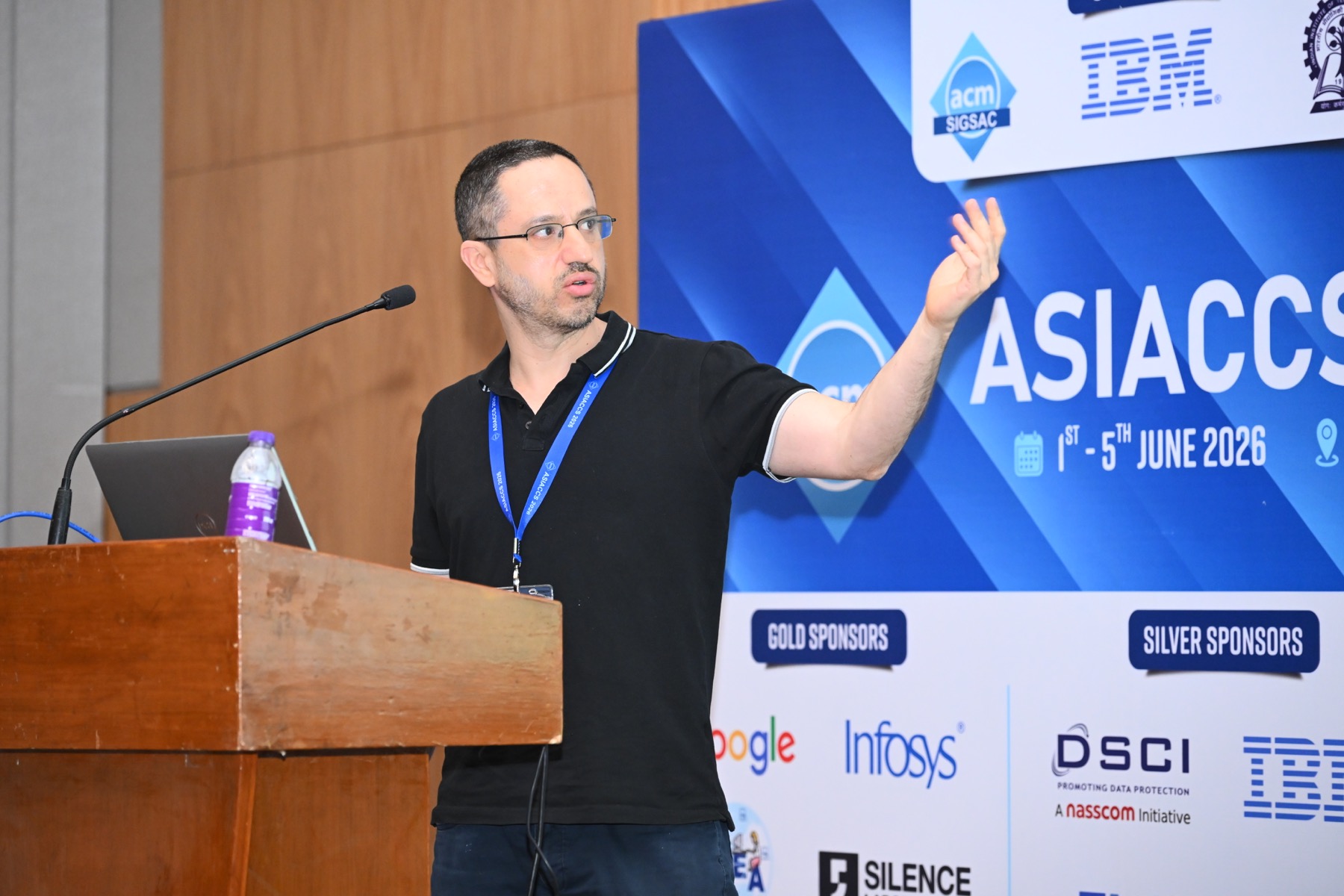
Presenting Aggios at AsiaCCS 2026
Interactive demo: run a full election with EPA proofs in your browser
High-Precision Exact FHE Made Simple, General, and Fast
Work on exact high-precision fully homomorphic encryption, focusing on practical techniques that make encrypted computation simpler to implement and faster to run.
High-Throughput Universally Composable Threshold FHE Decryption
Threshold decryption for FHE systems with a universal composability treatment and an implementation-oriented emphasis on throughput.
PCC: Re-architecting Congestion Control for Consistent High Performance
Performance-oriented Congestion Control replaces hardwired TCP reactions with sender-side experiments that optimize observed performance; the companion theory note analyzes the induced utility game and proves conditions for a unique fair stable state.
Proves uniqueness, fairness, and approximate convergence for the PCC utility game.
PCC Vivace: Online-Learning Congestion Control
An online-learning extension of the PCC architecture that improves convergence, latency, and TCP friendliness while remaining a deployable sender-side congestion-control protocol.
Axiomatizing Congestion Control
An axiomatic treatment of congestion-control objectives that asks what transport protocols should optimize, and what tradeoffs are unavoidable when they do.
Nash-Peering: A New Techno-Economic Framework for Internet Interconnections
A proposal for Internet interconnection agreements based on Nash bargaining, intended to make peering economics more flexible and less prone to dispute.
Capturing Resource Tradeoffs in Fair Multi-Resource Allocation: added impossibility result
A study of cloud resource allocation when jobs can trade among resources, with an extended technical report proving a stronger impossibility result for Pareto optimality, strategyproofness, and envy-freeness.
Shows that no mechanism can simultaneously satisfy Pareto optimality, strategyproofness, and envy-freeness.
Theoretical and Experimental Analysis of the Canadian Traveler Problem
A study of navigation under partial observability, including dependent edge failures, exact solving algorithms, and empirical comparisons for variants of the Canadian Traveler Problem.
Built Systems
Demos, prototypes & artifactsAggios Browser Demo
A full implementation of basic Aggios built around the EPA proof of partition, used as an unmodified black box: BLS delegation signatures, KZG registration tokens with cross-group EqLog proofs, aggregator tally proofs, a validator flow, a public bulletin board, and benchmarks from 10² to 10⁶ voters.
Why it matters: shows that verifiable large-scale aggregation can be demonstrated end-to-end in the browser, including proof generation and public verification.
The entire stack, including the EPA prover and verifier, compiles to WebAssembly and runs directly in the browser, so anyone can create an election, generate the proofs, and verify the tally on this site without any server.
A full Rust implementation of coercion-resistant e-voting based on the JCJ protocol and Civitas. Implements the complete cryptographic core: DVRP credential issuance, threshold ElGamal key generation, PET-based duplicate and invalid-credential elimination, a two-pass RPC MixNet with public verifiability, and distributed decryption, all wired into a runnable election pipeline with a web UI.
Why it matters: shows how coercion-resistant voting can be implemented as a complete election pipeline, not only as a protocol description.
The key insight of JCJ: a coercer can force you to vote under threat, but cannot prevent you from casting a silent override later. Your real vote always wins.
The Social Evidence
A browser extension for collaborative fact-checking. Select any text on a news page, attach a comment linking it to contradicting evidence, and every visitor with the extension sees the same annotations, turning passive reading into a shared, persistent record of public inconsistency.
Why it matters: shows how accountability infrastructure can live directly on the original source, visible to every reader, instead of on a separate fact-checking site.
Built around the idea that accountability needs infrastructure: not just the claim that a politician contradicted themselves, but a linkable annotation anyone can see on the original source.
Subsenate
GitHub →A zkSNARK-based e-voting system that randomly selects a community of judges from a pool of eligible voters: cryptographic sortition. Using zero-knowledge proofs, the selection is verifiably random and private: nobody can predict or manipulate who gets chosen, yet anyone can verify the result is fair.
Why it matters: shows how sortition can be made privately random and publicly verifiable using ZK proofs.
"Politicians and diapers must be changed often, and for the same reason." Subsenate takes the turnover problem seriously: sortition, the random selection of citizen decision-makers, powered Athenian democracy, and ZK proofs can make it verifiable today.
Aggios EPA Benchmark
GitHub →Benchmark code by Marius Lombard Platet for evaluating Aggios on EPA-style workloads, built to make the system's performance claims reproducible rather than anecdotal. The repository collects the scripts, inputs, and experiment scaffolding needed to compare configurations and understand where the implementation spends its time.
This kind of benchmark is the bridge between a cryptographic protocol and an implementable system: it turns asymptotic or architectural claims into measurements that other people can inspect, rerun, and challenge.
On Democracy
Values & convictionTo me, democracy is more than a form of government. It is a way of giving people real influence over the decisions that affect their lives. It is also delicate: easy to undermine, and much harder to design so that it is fair, resilient, and trustworthy.
This challenge has motivated much of my work in cryptography. I am interested in how cryptographic protocols can strengthen democratic institutions by reducing the need to trust the people who operate them, while preserving privacy, fairness, and public verifiability.
I have explored this idea from several directions. Aggios is a protocol I co-designed to make large-scale direct democracy more practical. It introduces Proof of Partition, a new zero-knowledge primitive that enables scalable, privacy-preserving aggregation for direct democracy. Subsenate is a sortition system based on zero-knowledge proofs that randomly selects citizen judges from a pool of eligible participants, an ancient idea implemented with modern cryptography. I also built CRelections, a complete implementation of a coercion-resistant electronic voting system, demonstrating how advanced voting protocols can be turned into practical software.
The question that motivates me is simple: how can we build democratic processes that people can trust, even when they do not trust the authorities running them?
Contact me
Feel free to reach out about research, collaborations, or just to say hello.